

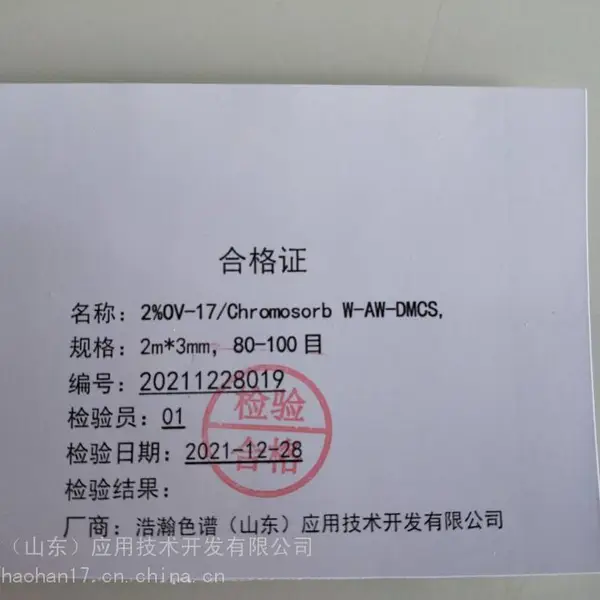
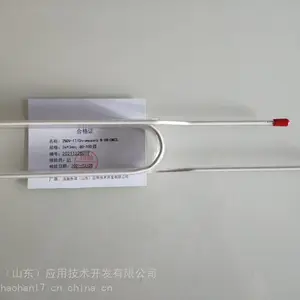
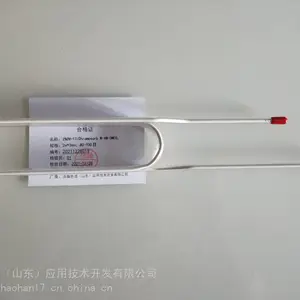

| 产品特性:稳定 | 是否进口:否 | 产地:滕州市 |
| 加工定制:是 | 品牌:浩瀚色谱 | 型号:1.5%OV-17/Chromosorb |
| 测量范围:99.9 | 测量对象:大米中杀虫双残留量 | 控温范围:170℃ |
| 尺寸:3000mm | 重量:0.02kg | 碳酸饮料:二氧化碳 |
| CO2:微量水分 | 食品级:可乐 | 聚酯瓶:PET |
| 医疗器械:环氧乙烷 | 13x:分子筛 | 氧:氮 |
| 甲烷:二氧化碳 | 溶剂解析:增塑剂 | :氢气 |
1.适用范围
本标准适用于大米中杀虫双、沙蚕毒素的残留量测定。本方法低检出限为0.1ng。
2.原理概要
大米样品经0.1mol/L盐酸提取后,在碱性溶液中,转化成沙蚕毒素,以三氯甲烷提取后,蒸除三氯甲烷,用甲醇定容1mL,以FPD-GC测定。
3.主要仪器和试剂
3.1.主要试剂
0.1mol/L盐酸、0.1mol/L氢氧化钠、0.1mol/L硫化钠水溶液。
甲醇(重蒸)、无水乙醇、无水硫酸钠。。
三氯甲烷:重蒸加无水乙醇,使含1%乙醇。
杀虫双标准溶液:称取杀虫双23.8mg,以甲醇溶解,稀释100mL,每毫升中杀虫双含量相当于沙蚕毒素100μg。 根据需要,吸取一定量上述标准溶液,以甲醇稀释一定体积,配制成应用液。杀虫双转化:相当于沙蚕毒素4μg的杀虫双,按下述条件转化,终浓度为每毫升含2μg沙蚕毒素。
沙蚕毒素标准溶液:称取沙蚕毒素草酸盐16.00mg,以甲醇溶解,稀释100mL,每毫升含沙蚕毒素100μg,根据需要,吸取一定量上述标准溶液,以甲醇稀释一定体积,配制成应用液。
3.2.仪器
台式离心机、旋转蒸发器、玻璃蒸馏器、氮气蒸发器、微量注射器
气相色谱仪(具火焰光度检测器)、一般玻璃仪器(略)。
4.过程简述
4.1.样品处理:
称取大米样品5g,加10mL 0.1mol/L盐酸溶液,在振荡器上振荡30min,于1600r/min离心10min,将上清液倒于带盖量筒中,再以10mL 0.1mol/L盐酸洗涤样品,如此重复三次。合并盐酸提取液,调节pH8.5~9,加0.1mol/L硫化钠溶液2mL放置过夜,加2倍样品液体积的三氯甲烷于分液漏斗中,剧烈振摇1min,静置分层。将三氯甲烷层经无水硫酸钠滤于三角瓶中,在旋转蒸发器中45℃蒸除氯仿,剩余少许时,立即取出,用甲醇定容1mL,待测定。
4.2.气相色谱条件:
色谱柱:3mm(内径)×2m玻璃柱;填装涂有1.5% OV-17 Chromosorb.W(80~100目)的担体。
温度 柱温:160℃;汽化室温:200℃;FPD检测器温:170℃。
气体速度:载气(氮气)流速:70mL/min;氢气流速:150mL/min;空气流速:50mL/min。
其他条件:仪器灵敏度:×102;衰减:×32;纸速:0.5cm/min。
4.3.测定:
按上述色谱条件调试仪器,待仪器稳定后,用微量注射器注入样品或标准液,以保留时间为定性指标。取杀虫双转化后相当于0.5、1、2、3、4、5ng的沙蚕毒素,注入色谱仪中,测量峰高。以杀虫双含量为横坐标,峰高为纵坐标,在双对数坐标纸上绘制工作曲线,根据样品的峰高定量。
5.结果计算
式中:X——样品中杀虫双含量,mg/kg;
B——测得样品的峰高(或面积)值,查标准曲线后得到的沙蚕毒素量,ng;
V——定容体积,mL;
A——进样量,μL;
m——样品质量,g。
杀虫双分子量为355,沙蚕毒素分子量为149,将测得的沙蚕毒素量乘以2.38,即为杀虫双含量。
7.度
大米样品添加回收实验结果的变异系数小于20%。
8.其他
名称:玻璃柱
规格:3mm(内径)*2m
型号:1.5%OV-17/Chromosorb W(80-100目)
应用:GB/T 5009.114-2003 大米中杀虫双残留量的测定
适用于岛津各种型号的气相色谱仪GC2010,GC-2014

1. Scope of application
This standard is applicable to the determination of the residues of ciprofloxacin and necrotoxin in rice. The minimum detection limit of this method was 0.1 ng.
2. Principle outline
After the rice sample was extracted with 0.1mol/L hydrochloric acid, it was converted into necrotoxin in an alkaline solution, extracted with chloroform, evaporated to remove chloroform, made up to 1mL with methanol, and determined by FPD-GC.
3. Main instruments and reagents
3.1. Main reagents
0.1mol/L hydrochloric acid, 0.1mol/L sodium hydroxide, 0.1mol/L sodium sulfide aqueous solution.
Methanol (re-distilled), anhydrous ethanol, anhydrous sodium sulfate. .
Trichloromethane: redistilled and added absolute ethanol to make 1% ethanol.
Insecticidal double standard solution: Accurately weigh 23.8 mg of insecticidal bisulfite, dissolve it in methanol, and dilute to 100mL. The content of insecticidal bisulfite per ml is equivalent to 100 μg of necrotoxin. As required, draw a certain amount of the above standard solution, dilute it with methanol to a certain volume, and prepare an application solution. Insecticidal double transformation: Insecticidal double equivalent to 4 μg of necrotoxin was transformed according to the following conditions, and the final concentration was 2 μg of necrotoxin per milliliter.
Neretoxin standard solution: Accurately weigh 16.00 mg of necrotoxin oxalate, dissolve it in methanol, and dilute to 100 mL. Each milliliter contains 100 μg of necrotoxin. As needed, draw a certain amount of the above standard solution and dilute it to a certain volume with methanol. , formulated into an application solution.
3.2. Instruments
Benchtop centrifuges, rotary evaporators, glass stills, nitrogen evaporators, microinjectors
Gas chromatograph (with flame photometric detector), general glass instrument (omitted).
4. Brief description of the process
4.1. Sample processing:
Weigh 5 g of rice sample, add 10 mL of 0.1 mol/L hydrochloric acid solution, shake on a shaker for 30 min, centrifuge at 1600 r/min for 10 min, pour the supernatant into a graduated cylinder with a lid, and wash the sample with 10 mL of 0.1 mol/L hydrochloric acid , and so on three times. Combine the hydrochloric acid extracts, adjust the pH to 8.5-9, add 2 mL of 0.1 mol/L sodium sulfide solution and leave overnight, add 2 times the volume of the sample solution in chloroform, shake vigorously for 1 min, and let stand for stratification. The chloroform layer was filtered through anhydrous sodium sulfate into a conical flask, and the chloroform was evaporated at 45°C in a rotary evaporator. When there was a little remaining, it was taken out immediately, and the volume was made up to 1 mL with methanol, to be determined.
4.2. Gas chromatography conditions:
Chromatographic column: 3mm (inner diameter)×2m glass column; packed with a carrier coated with 1.5% OV-17 Chromosorb.W (80-100 mesh).
Temperature Column temperature: 160°C; vaporization room temperature: 200°C; FPD detector temperature: 170°C.
Gas velocity: carrier gas (nitrogen) flow rate: 70 mL/min; hydrogen flow rate: 150 mL/min; air flow rate: 50 mL/min.
Other conditions: Instrument sensitivity: ×102; Attenuation: ×32; Paper speed: 0.5cm/min.
4.3. Determination:
Adjust the instrument according to the above chromatographic conditions. After the instrument is stable, inject the sample or standard solution with a micro-syringe, and take the retention time as the qualitative index. Take the necrotoxin equivalent to 0.5, 1, 2, 3, 4, and 5 ng after the insecticidal double transformation, inject it into the chromatograph, and measure the peak height. Taking the content of insecticidal double as the abscissa and the peak height as the ordinate, draw the working curve on the double logarithmic coordinate paper, and quantify according to the peak height of the sample.
5. Result calculation
In the formula: X——Insecticide content in the sample, mg/kg;
B——The peak height (or area) value of the measured sample, the amount of necrotoxin obtained after checking the standard curve, ng;
V——constant volume, mL;
A——Injection volume, μL;
m——sample mass, g.
The molecular weight of the insecticidal double is 355, and the molecular weight of the necrotoxin is 149. Multiply the measured amount of the neretoxin by 2.38, which is the content of the insecticidal double.
7. Precision
The coefficient of variation of the experimental results of adding and recovering rice samples was less than 20%.
8. Others
name: glass column
Specifications: 3mm (inner diameter) * 2m
Model: 1.5%OV-17/Chromosorb W (80-100 mesh)
Application: GB/T 5009.114-2003 Determination of Pesticide Residues in Rice
Suitable for various types of Shimadzu gas chromatographs GC2010, GC-201

浩瀚色谱(山东)应用技术开发有限公司(原滕州市浩瀚色谱仪器技术服务有限公司),坐落于鲁南地区古为“三国五邑之地、文化昌明之邦”的滕州市,这里历史悠久,文化源远流长,诞生了造车鼻祖奚仲,战国四公子孟尝君,还有“毛遂自荐”的故事流传至今。 浩瀚色谱是以开发色谱应用新技术,完善与补充国标,建立疑难产品的色谱分析方案为主攻方向的科技企业。浩瀚色谱为您提供全套创新解决方案,帮助您掌握新兴色谱应用技术,为您提供准确、全面的数据,帮助您做出明智决策,让您更快获得结果。 经营范围: 1.防腐专用高端气相色谱仪及高效液相色谱仪等色谱仪器技术开发,技术推广及技术咨询; 2.气相色谱填充柱及毛细管柱的生产; 3.2010及2015版中国药典二氧化碳(CO2)专用净化装置的研制; 4.在线仪器,仪表的的研发生产; 5.安捷伦(Agilent),岛津(Shimadzu)等进口仪器及国产色谱仪器的升级改造; 6.新型高效甲烷转化炉(CH4)的研制生产; 7.裂解进样器,顶空进样器及热解吸仪的研发; 8.承接样品的检测业务,并出具测试报告; 9.建立复杂样品的分析方案; 10.氮气发生器,氢气发生器,空气发生器,除烃仪(零级空气发生器)及氮氢空一体机的组装。 11.销售:实验室设备。 特色产品: 1.防腐专用气相色谱仪 检测产品:氟气(F2),氟化氢(HF),一氯化硫(S2CL2),二氯化硫(SCL2),硫单质(S),硫化氢(H2S),氯气/液氯(CL2),氯化氢(HCL),氨气/氨水(NH3),氯乙酸,氯乙酰氯,三氟乙酰氯,四氟化硫(SF4),磺酰氯,氯化亚砜,三氯氢硅,电子工业用二氯硅烷,三氯化氮,光气等。 2.氮氧化物测定专用气相色谱仪 检测产品:一氧化氮(NO),一氧化二氮(N2O),二氧化氮(NO2),四氧化二氮(N2O4)等。 3.中国药典二氧化碳专用净化装置:HHO-III Purification device 4.岛津U型不锈钢填充柱的通用型改造。 5.高效通用型甲烷转化炉的研发生产。 6.安捷伦-岛津填充柱的互联互通。 7.岛津-安捷伦填充柱/毛细管柱的互联互通。 8.过氧化物分析专用气相色谱仪
点击查看>| 企业类型 | 有限责任公司(自然人独资) | 注册资本 | 401.10万人民币 |
| 公司注册地址 | 山东省枣庄市滕州市荆河街道红荷大道智贸城12幢1单元315号房 | 统一社会信用代码 | 91370481MA3CLD3F51 |
| 登记机关 | 滕州市市场监督管理局 | 法定代表人 | 王晓莹 |
| 公司成立日期 | 2016-11-11 | 营业期限 | 2016-11-11 至 无固定期限 |
| 经营范围 | 色谱仪器技术开发、技术推广及技术咨询;销售:实验室设备。(依法须经批准的项目,经相关部门批准后凭许可证方可开展经营活动) | ||
-
¥1200.00
-
¥2600.00
-
¥4800.00
-
¥4800.00
-
¥4800.00
-
¥4800.00
-
¥4800.00
-
¥4800.00
-
¥7800.00
-
¥12.8万
-
¥5600.00
-
¥1200.00
